
Tracing a Lorain County Street by Address
An address-led Lorain County search begins in the Auditor’s property system. Enter the location, preserve the returned property number and situs address, and note the tax year. The property number is the stable handoff between the Auditor, the map, and recorded documents. A situs address is the location assigned to the parcel for county records; it may not match a mailing address. From there, use the GIS view for parcel context and the Recorder’s document index for the recorded property trail. A current owner label is a property clue, not proof of continuous residence.
- Run the address in the Lorain County Auditor Location Search and record the property number, situs address, and tax year used.
- Open the Auditor-linked parcel viewer and use the property number to place the parcel in its street setting. Note only adjoining parcel numbers that are visible in the viewer.
- Use the known owner or parcel clue in the Recorder’s documented property-search workflow, then enter the PAX record process to reach a recorded instrument.
- Read the actual document image for party names, recording date, instrument or book and page reference, legal description, and parcel reference. Repeat from the prior party when tracing an older transfer.
- For a named-person check, use the Ohio voter screen only with a first name, last name, and county. Older household clues belong in library directories and local newspapers, not in a street-browsing voter search.
That sequence keeps the evidence in order: address, parcel, recorded document, then a separately dated household clue. It also avoids treating a parcel boundary as a survey or treating a deed as a full household list.
Lorain County Street Directory Search Fields
The Auditor is the main Lorain County street directory entry point because its property application accepts several address forms. Its public landing screen also labels the broader route as a search by parcel, owner, or address. Location Search is more precise than a single free-text line: separate direction, suffix, unit, and city or ZIP components help normalize an address before a parcel search. The result should be carried forward as a county property number, rather than retyping a shortened street name into each later system.
| Auditor field | Input type | Use in an address search | Verified note |
|---|---|---|---|
| Tax Year | Selector | Sets the inspected tax-year context | Shown across the inspected search screens. |
| Street Number and Street | Text | Build the core location query | Street is needed for a productive address search. |
| Pre-Direction, Suffix, Post-Direction | Selectors | Distinguish the printed street form | Optional location components; option lists were not captured. |
| Unit Designator and Unit | Selector and text | Refine a unit address | Optional location components. |
| City, State ZipCode | Selector | Add local delivery context | It is an address component, not a confirmed ZIP-wide roster tool. |
| Property Number | Text | Move from an address to one county parcel | Used on Number Search. |
The Auditor also offers Name, Number, Sales, and Custom searches, plus real-estate and manufactured-home categories. Sales and Custom screens expose property-oriented filters such as sale ranges, building characteristics, land use, tax district, school district, owner, location, and acreage. Use those screens to refine property research, not to construct a household roster.
The Lorain County Treasurer has a separate parcel, name, and address tax search. It can help check tax-account context after a parcel match, but it does not replace the Auditor’s valuation role or the Recorder’s document custody.
The Treasurer search route is shown in this Lorain County address-records image.
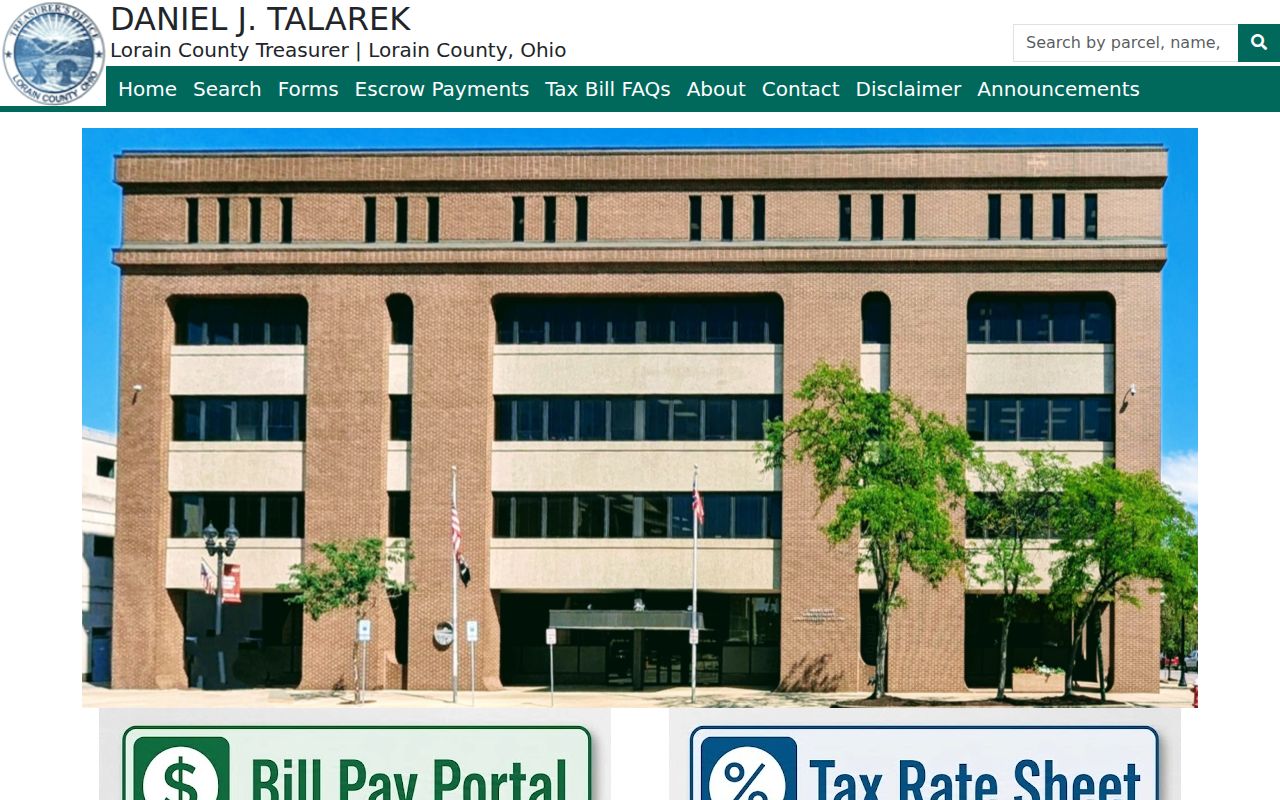
A tax-account screen is best read beside the Auditor property number, not as a stand-alone finding about who occupies an address.
Lorain County Parcels on the GIS Portal
The Auditor’s GIS & Tax Map page links to a Parcel Viewer, GIS Portal, and GIS Open Data Portal Site. The dynamically rendered viewer was not captured well enough to claim a complete layer list or export feature. The careful Lorain County method is to find one address in the Auditor, retain the property number, locate that parcel in the viewer, and then return to Auditor search for any adjoining property number seen on the map. Map context helps place a parcel along a street, but it does not replace a recorded legal description or survey.
The Lorain County GIS Portal is the source of this parcel-mapping image.
Use a mapped parcel edge as a research aid, then confirm the legal description on the relevant recorded instrument or plat.
Note: Lorain County’s GIS tools provide geographic context, while the Recorder remains the custodian for recorded property documents.
Lorain County Recorder Documents by Street
Recorder PAX is the document side of an address-records search. The Recorder documents a name, parcel-number, and date route, but account creation or login is required. Start with legal last and first name in Name Search. For parcel work, switch to Advanced Search, clear the name fields, and enter the parcel number without dashes. Select a record, then use Instrument to open or print the document image. The Recorder does not publish a verified online beginning year, so an online miss is a reason to ask at the Recorder counter, not a reason to assume the document never existed.
The title trail can include deeds, certificates of transfer, mortgages, releases, easements, liens, plats, affidavits, and related instruments. Record each real party role and the document date before moving backward. The Recorder does not provide title opinions, so a single deed or current owner label cannot settle every ownership question.
Recorder DTS Public Access is the source of this Lorain County address-records image.
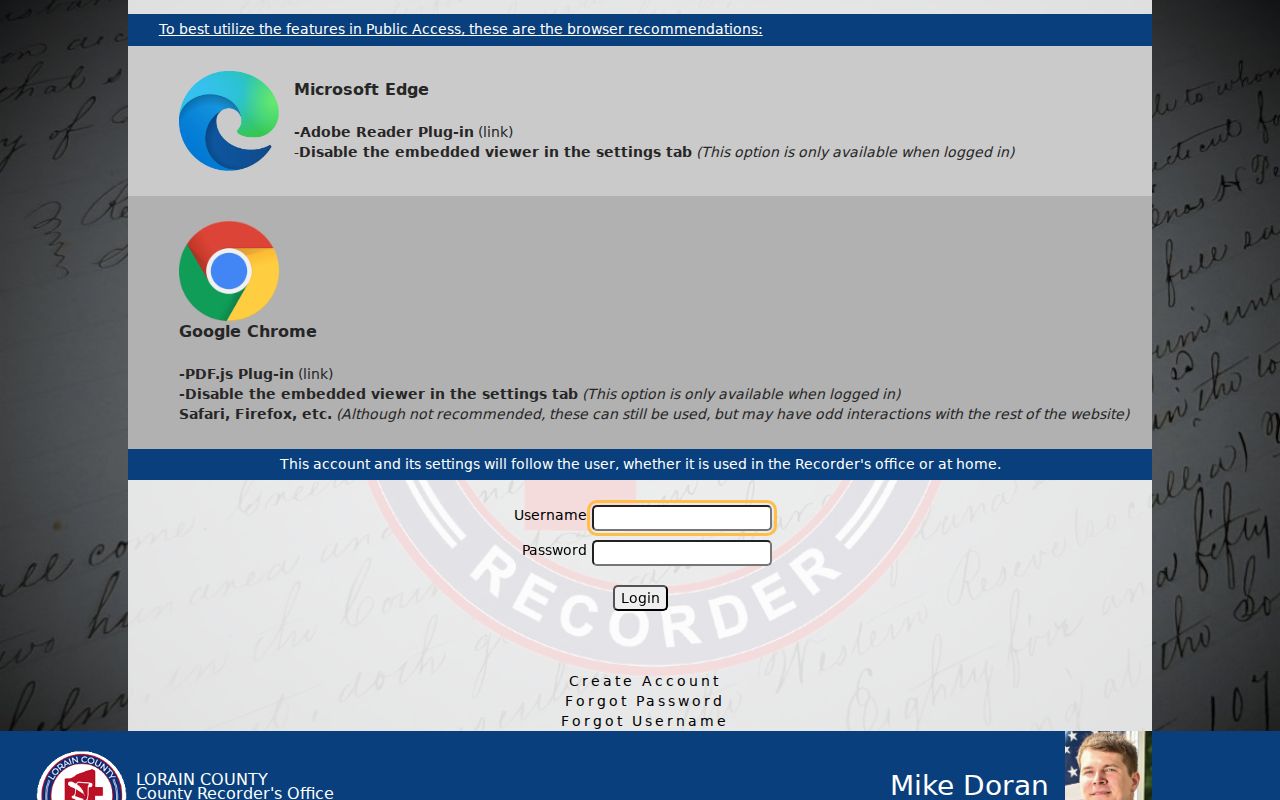
Recorder instructions send a researcher from a selected record to the Instrument image, where the actual document should be read rather than inferred from a search label.
The Recorder’s counter is at 226 Middle Ave., Room 102, Elyria, with public hours Monday through Friday, 8 a.m. to 4 p.m. Regular copies are $2 per page, and certified copies are $2 per page plus a $1 seal fee. The office’s fees and documents page also lists address and personal-information redaction request forms.
Lorain County Street Permits and Requests
Address-keyed administrative records can add a date or project clue, but Lorain County research should not pretend there is a public permit screen for walking every street. The City of Lorain’s permit page publishes applications for demolition, electrical work, fence work, foundation repair or waterproofing, HVAC, plumbing, residential building, additions, pools, vacant-property registration, lot splits, plats, conditional uses, and zoning appeals. Completed forms may go to bhp@cityoflorain.org or be delivered in person. The Building Division is reachable at 440-204-2045, and the Chief Building Official at 440-204-2034. For a released record, give the custodian the address, the record type, and an approximate period.
City of Lorain permit applications are shown in this Lorain County address-records image.
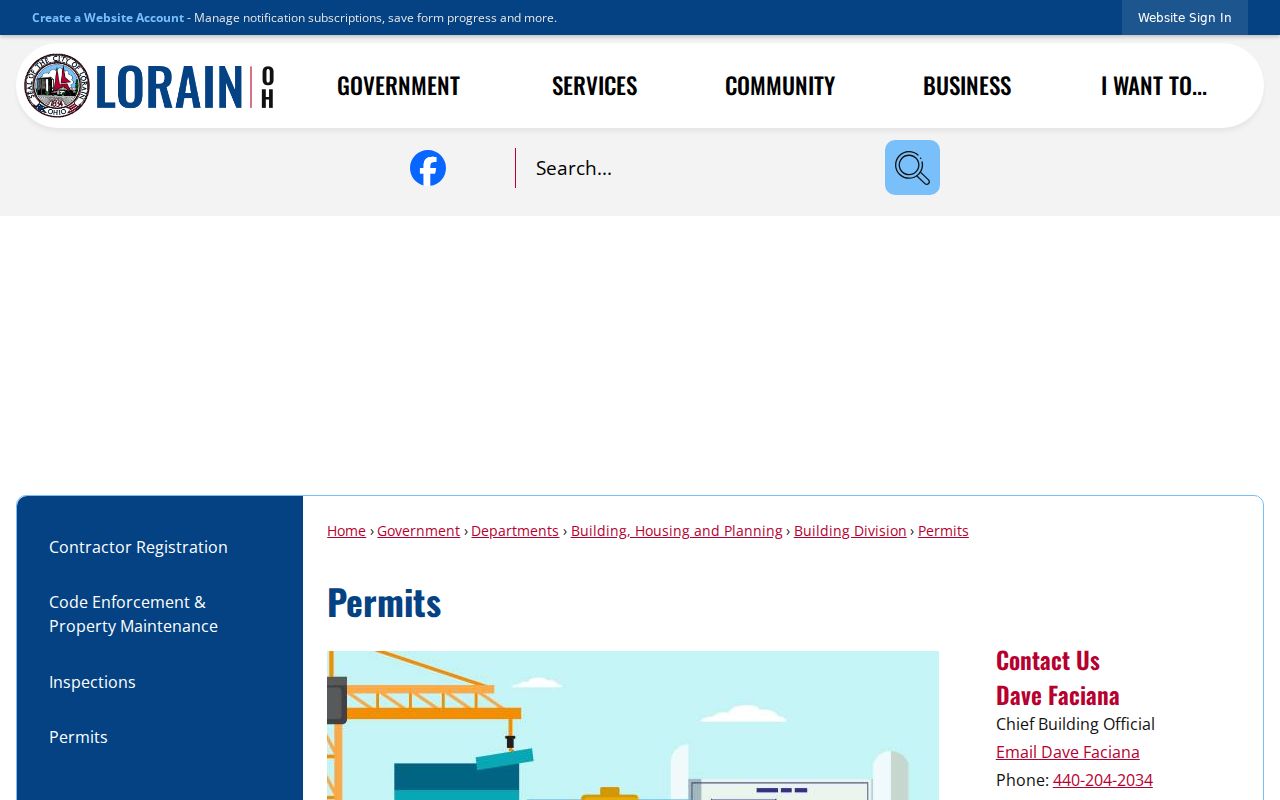
The City lists Building Division contact routes, while a specific public-records request remains the route for an address-specific administrative file that is not openly searchable.
For county administrative records without a portal, Ohio’s Public Records Act, ORC 149.43 is the written-access route, subject to redactions and the responsible office’s rules.
Franklin Street and Fifth Street
Historic address work has a local naming trap. A Lorain County Memory item identifies Franklin Street as today’s Fifth Street in a photograph dated about 1905 to 1910. That does not prove a countywide renumbering rule. It does mean that a modern address search can miss a real older reference if the printed historic name is silently converted. Before matching an old directory or newspaper item to a current parcel, compare the date, an identified historical image, a plat or official map, and the recorded legal description.
The same caution applies to older references to Charleston or Black River Township. Those names can appear in early local materials. Keep the historic label in the notes beside the current property number until the link is supported by a record.
Recorder property-search guidance is shown in this Lorain County address-records image.
Using the documented name, parcel, and date paths keeps a historic street-name question tied to verifiable record identifiers.
Lorain County Address Records Compared
Several Lorain County sources can be keyed to an address, yet each answers a narrower question. The coverage below keeps ownership records, map context, tax accounts, permits, historical sources, and voter confirmation in their proper lanes. The Ohio voter screen requires a known first name, last name, and county; it is not a public tool for browsing residents by street. A dated county registration archive is a separate public-record channel subject to statutory release limits and Board of Elections guidance.
| Address record | Custodian | What it can show | Access boundary |
|---|---|---|---|
| Auditor Location Search | Lorain County Auditor | Property number, situs address, and tax context | Public address route; owner and tax information are not household identity. |
| GIS and Parcel Viewer | Auditor GIS | Parcel placement and visible adjoining parcel numbers | Use the property number; a map is not a legal survey. |
| Recorder PAX | Lorain County Recorder | Recorded instruments and document parties by name, parcel, or date | Account portal or counter; no verified online cutoff is published. |
| Tax account search | Lorain County Treasurer | Parcel, name, or address tax-account context | Not a resident list or a replacement for Recorder documents. |
| City permits | City of Lorain Building Division | Project or responsible-party clue where a record is released | No verified open public street search. |
| Directories and newspapers | LPLS and LCHS | Historical name and address clues | Voluntary or incomplete by source and edition. |
| Voter individual lookup | Ohio Secretary of State | One named person’s registration context where public | First name, last name, and county required; not street browsing. |
The Ohio Voter Search is useful after a person has been identified from a separate record. If the aim becomes a historical household rather than a current parcel, the Lorain County City Directories collection has the local shelf and newspaper route.
Terms in a Lorain County Street Directory
Street research works better when each key is named correctly. The Auditor distinguishes the parcel location from tax and district information. The Recorder’s legal description can preserve the link when a printed street label changes. A historic directory can add a household clue, but the local research found no verified countywide reverse or criss-cross run to use as a complete street list.
- Parcel
- A county property unit identified by a property number and used to connect the Auditor result, GIS context, and recorded documents.
- Situs address
- The location address used in county property records. It is distinct from a mailing address, which should not be assumed from an inspected Auditor result.
- Plat
- A recorded map or subdivision description that can help reconcile a historic street reference with the legal description.
- Criss-cross directory
- A directory arranged by street rather than by surname. No countywide Lorain run was verified, so treat it as a possible format to ask a holding library about, not a confirmed local roster.
Lorain County’s Recorded Street Trail
The Recorder reports an average year of 35,515 documents, including 22,122 e-recordings and 9,937 deeds. Those figures describe the volume moving through the office, not the number of people who live in Lorain County. They do explain why a street-by-street search needs a stable parcel number and careful document dates. A broad name result may include mortgages, releases, affidavits, plats, or other filings that do not transfer title.
Land records in Lorain County begin in 1824, but the Recorder does not publish a reliable online-only starting year. When an older record is missing from PAX, use the Recorder counter or ask about the relevant deed-book and index access rather than filling the gap from an unsourced address list.
Note: A documented instrument records a property event, while residence still needs separate, dated evidence from an appropriate source.
Limits of a Lorain County Street Directory
A Lorain County street directory can connect public parcels, property documents, historical listings, and one-person voter confirmation. It cannot identify every renter, household member, protected resident, delivery recipient, utility customer, or person connected to a private DMV record. Even a property owner, permit applicant, and directory entry may refer to different people at different times. Treat an absence as a limit of that source, not proof that no one lived there.
Lawful use. Use Lorain County address records for personal, lawful research and keep their privacy limits intact. Do not use a parcel, directory, or document trail to stalk, harass, intimidate, or harm anyone; protected records and Safe at Home confidentiality rules can also limit public release.
Ohio Safe at Home protects qualifying participants’ confidential information, including protected voter information. The Ohio Safe at Home program and the responsible custodian are the proper sources for a confidentiality question. For records focused on one named person rather than an address, use the separate Lorain County Resident Lookup workflow.